Showing posts with label 1989. Show all posts

22 January 2026

Bathory: Albums (1988-91)

Bathory: Albums (1988-91)

I once heard someone describe the Blood Fire Death (1988) album as a collection of quality songs. The description is certainly valid, but it's also a vast understatement of the truth. BFD is a ground-breaking, momentous human achievement, the importance of which cannot be overstressed. Like the eponymous début album, it delivered something unprecedented that made everyone else sit up and take notice.

The thundering intro, the use of acoustics, the Viking symbolism, the choirs, the cleaner vocals, the pounding drums, the torturing wail of the electric guitars, the Pure Fucking Armageddon heaviness of it all was something that the world hadn't experienced before. In short, it changed the face of metal and made Quorthon a living legend.

24 December 2025

Lone Wolf and Child: Assassin on the Road to Hell (1989)

LWaC: Assassin on the Road to Hell (1989)
Dir. Tokuzô Tanaka

Tanaka's film attempts to tell the entire Lone Wolf and Cub story in just 140 minutes, which is an insane undertaking. Nevertheless, it's a valiant attempt and an enjoyable evening's viewing for samurai fans.

Hideki Takahashi stars as the Shogun's one-time executioner, Ōgami Ittō. He does a damned good job at it, able to show compassion when the situation calls for it, but just the right amount because too much might compromise his stoic attitude. He's also deft enough with the dōtanuki to be believable.

Young Daigoro is played by Koji Aeba. It's a wholly subjective view, but for me young kids in Japanese films tend to be much less irritating than young kids are in most American films. Daigoro isn't just a third wheel in the Lone Wolf story, or some kind of amusing gimmick, he's an integral part of the tale and, thankfully, while Koji was likely too young to understand the importance of what he was asked to do onscreen, he at least carried it without fault and without ever being irritating. GJ, kid.

3 October 2025

The Karate Kid: Movies (1984-94)

The Karate Kid: Movies (1984-94)
Dirs. John G. Avildsen (Movies #01-03) / Christopher Cain (Movie #04)

01
. The Karate Kid (1984). After moving to California with his mom, Daniel LaRusso (Ralph Macchio) quickly makes an enemy of a clichéd high school bully. Both parties have an interest in karate, which adds flavour to what's on the surface a straightforward 80s underdog story.

There are teenager levels of romance to contend with, but it's illustrated with the best intentions, so it's not as forced as it could've been.

The real treasure is the believable sincerity that characterises the relationship that Mr Miyagi (Pat Morita) has both with the eager-to-learn Daniel and the wider world, as a whole.

Morita's understated performance keeps Miyagi as a supporting character while simultaneously elevating him to become the true emotional core of the story. With a single wordless glance he can communicate a whole chapter's worth of feelings. He embodies what belief, patience, wisdom, and sensitivity can accomplish when each element achieves balance.

1 September 2023

James Bond: Timothy Dalton (1987-89)

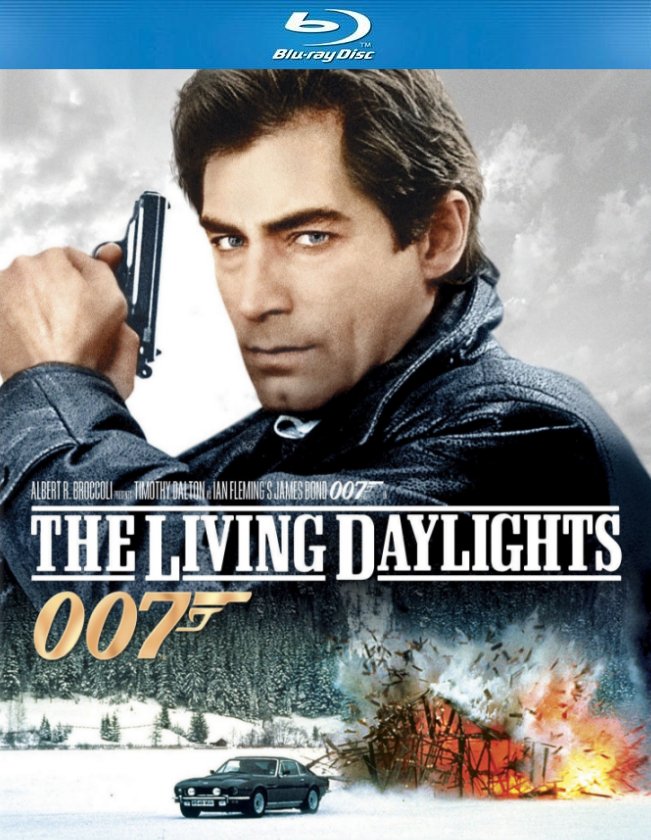
The Living Daylights (1987)
Dir. John Glen

In all probability this'll be the last James Bond movie post that I make, unless it comes down to the only Christopher Lee film I've not written about is the Bond one that he co-starred in. But that's damned unlikely, considering he's got 278 credits on IMDB and I'd sooner watch the 277 in which he doesn't have a supernumerary nipple.

I digress; I'm here to talk about Timothy Dalton. I mean no disrespect when I say that Dalton's Bond doesn't have the same level of sex appeal as Sean Connery's. Very few men do. On the plus side he doesn't have the same kind of 'charm' as Moore's. No, instead Dalton brings a moodiness to the role, and a sense of daring that the others had less of.

There's a feeling that he's worked hard to earn his 007 Licence, whereas for the others it came easy.

25 June 2022

Kiki's Delivery Service (1989)

Kiki's Delivery Service (1989)
Dir. Hayao Miyazaki

Tradition dictates that at age thirteen a young witch should leave her home behind, in order to continue her training elsewhere.

For Kiki, it's an adventure that ends up being equal parts hard work; but she's headstrong when necessary, and with the help of her friend Jiji (a cat), she strives to make her mark.

With delicate pacing and timely underpinning it teaches us that each person has a purpose, even if they aren't aware of it or don't consider what they do to be anything special. 

If you dare to rise to a challenge, do your best for yourself and for others, like Kiki, then the rewards can more than equal the effort put in.

It's not action-packed and doesn't need a dramatic setting to be appreciated (you can watch it on a sunny day), but it's refreshingly sincere, and the attention to detail in environments is noteworthy, making the houses feel lived-in, which gives them a beauty all of their own.

There's a scene during the closing credits, so don't turn off too soon, if you want to see it.

17 October 2021

Godzilla: Heisei Era Films (1984-95)

16. The Return of Godzilla (1984)
Dir. Koji Hashimoto

NOTE: numbering continues sequentially from the Shōwa Era. For simplicity's sake I've used English language titles for each of my Godzilla reviews, but it's always the original Japanese language versions of the films that I refer to.

The Heisei Era is almost exclusively a case of Godzilla vs [ANOTHER] kaijū; the exception is the first film, which is a reboot of sorts, being a sequel to the original 1954 film that ignores the other fifteen Shōwa films. It was a deliberate attempt to return the series to its origins. It successfully made Godzilla scary again. No longer something to be mocked, Godzilla is total fucking destruction.

The first proper reveal of the rejuvenated beast is impressive, with newly added facial animatronics that enabled it to have nuances like never before.

12 January 2021

Violent Cop (1989)

Violent Cop (1989)
Dir. Takeshi Kitano

In Takeshi Kitano's début feature film as director he stars as Azuma, a pissed-off detective with some unorthodox methods. Azuma uses violence often because he knows it gets results. It's administered methodically but can sometimes appear casual. He'll bitch-slap and humiliate anyone he feels deserves it, but when events turn personal, when his role as protector is compromised, the level increases and is sustained for longer.

Hisashi Nozawa is credited as sole writer but Kitano made such significant script revisions that in the end his persona dominates all parts of it. The transposition of honed comedy timing into filmmaking style make the changes in tone swift and unexpected, like a good joke or a cutting remark.

7 August 2020

The Incredible Hulk: Original Movie Collection (2018)

The Incredible Hulk:
Original Movie Collection (2018)
Dirs. Nicholas Corea / Bill Bixby | 3 Films, approx 272 mins (total)

The 2018 date given above refers to the three-disc DVD box-set released by Fabulous Films in that year, but the three films themselves are from much earlier (1988-90). They're set after The Incredible Hulk TV series (1977-82) that starred Bill Bixby and Lou Ferrigno as scientist David Banner and his alter-ego, respectively.

The Incredible Hulk Returns (1988)
Dir. Nicholas Corea

It's been two years since David Banner burst his shirt and trousers in a green rage. He's in a stable relationship and working on a gamma transponder that could potentially rid him of his alter ego forever, but a face from his past upsets the apple cart, and pesky reporter Jack McGee (Jack Colvin) is back on Banner's trail again.

19 May 2020

A Nightmare on Elm Street: Films (1984-2003)

01. A Nightmare on Elm Street (1984)
Dir. Wes Craven

Prior to re-watching the first of the Elm Street movies recently, it had been well over a decade — perhaps even closer to two — since I'd last seen it, but I remembered almost every scene as if it was yesterday. It's because I'd watched it many times on an ex-rental VHS as a teenager. In all honesty, and accounting for nostalgia, it holds up rather well.

If you're not familiar with the set-up, it's the story of a group of teenagers, all of whom reside on the titular Elm Street, whose dreams are haunted by a killer with blades on one gloved hand. The killer's reasons for doing what he does are part of the film's plot, so I won't delve any deeper than that.

One of the movie's strengths is its atmosphere, and by polluting the safety net of the unconscious, by turning a place of retreat into a realm of pure terror for the story's protagonists, it sticks in the mind.

28 January 2020

Nine Inch Nails: Pretty Hate Machine (1989)

NIN: Pretty Hate Machine (1989)

My introduction to NIN was a track that was featured on a UK magazine cover-mounted sampler CD. I can't recall from which magazine it came, I think it may have been a short-lived one, but I'm pretty sure the track was Last from the Broken E.P. (1992).

The same disc had a track by Therapy? from their Nurse (1992) album, and one from Pigface's Fook (1992). Seeing as how all three releases are from the same year, I think it might be safe to assume that it was '92 when I first heard NIN.

The sampler did its job. I wanted more. After buying Broken and its remix album, Fixed (both 1992), I eagerly sought out the début album, Pretty Hate Machine (1989). I acquired it on vinyl and was surprised to find that it was different from what I expected - it was more like Depeche Mode than the Industrial anger of Broken.

3 October 2019

Bill and Ted's Excellent Adventure (1989)

Bill and Ted's Excellent Adventure (1989)
Dir. Stephen Herek

B+TEA is special to me for a reason that may bore almost everyone, but I feel obliged to relate it because I love the film and owe it at least that much, for what I feel it gave to me.

I saw it first at a time in my life that was, let's say, pivotal in learning about who I was as a person and how my actions affected others.

I bought it back when VHS was the dominant home media format and watched it many, many times - I knew every scene by heart.

Alas, it happened that one evening a VHS tape was needed at VERY short notice in order to record from TV something that was even more beloved (i.e., Star Trek: TNG) and the B+TEA tape was the only one available...

18 September 2019

The Almighty: Studio Albums (1989-93)

Blood, Fire and Love (1989)

I discovered Blood, Fire and Love, the band's début album, when I was about sixteen-years-old. I wasn't that age when the record was released, just that age when I discovered it. But that's not important. What's important is that after half a dozen playthroughs I began to think it was great, believing it could be the sound that would ultimately destroy pop-tinged Hair Metal.

I thought it was a Rock album for the ages, the perfect soundtrack to a night of cheap cider and trying (mostly in vain) to get one's leg over.

Hearing it again after so many years have passed made me smile guiltily and a little shamefully.

1 May 2019

Star Trek V: The Final Frontier (1989)

Star Trek V: The Final Frontier (1989)
Dir. William Shatner

I love all but one of the TOS films. I've watched them dozens of times and would never want to be without them. I've upgraded from VHS to DVD to Blu-ray. I've gave Paramount more money than they probably deserve for the same film over and over. Nevertheless, even from a vantage point of that nature, I'm able to look at them objectively. So, Star Trek V... eh? Set phasers to critique.

It's new challenges time and a new ship for the old crew. There's a problem in the Neutral Zone (again) and only Captain Kirk can sort it out. Why only Kirk? Because he's William Shatner, of course. Oh, and he's now also the film's director.

I doubt that anyone who isn't a Trek fan would've made it this far into the films, so I'll not be saying anything that deep down most fans don't already know. The Final Frontier has got some problems.

5 July 2018

Wrathchild America: Climbin' the Walls (1989)

Wrathchild America: Climbin' the Walls (1989)

It saddens me to admit it but there's nothing spectacular about Wrathchild America's début album. That might seem a strange thing to write, but it's because the release is one of a small number of records that connects me to a place and era that really defined me as a person, even though I wasn't aware of it happening at the time.

So, while the album is an important one in my life, I know that in reality it's merely a decent late-80s Metal album with solid drumming, some respectable Iron Maiden moments, and Thrash elements that serve their purpose but never manage to drag the songs out of the mediocre pit.

Despite its failings, and my own sentimental reasons for remembering and every few years rediscovering its limited charms, I still genuinely enjoy Climbin' the Walls as a musical piece. There's a faithful (if uninspired) cover of Pink Floyd's 'Time' on side two, which is what first brought it to my attention a long, long time ago. When last I checked it was available on YouTube, if you're interested in hearing any of it.

3 October 2017

Doctor Who: Sylvester McCoy (1987-89)

Doctor Who: Sylvester McCoy (1987-89)
The Seventh Doctor | 42 episodes, approx 25 mins each.

Given the name of the blog that you're presently reading it seems fitting that I should give Scottish actor Sylvester McCoy's incarnation of Doctor Who a post of his own, seeing as how he was the Seventh Doctor and, as it was believed at the time, the last.

But you can't keep a good Time Lord down, and it turned out that he was merely the last incarnation in what's since become known as the 'Classic Era' of the show, which began in 1963 with English actor William Hartnell.

McCoy's introduction was atypical in the series history because he was introduced at the beginning of a new season (Season 24), rather than at the end of a previous one.

But that's the only noteworthy aspect of his arrival. The actual regeneration scene, in which he transforms from a fatally injured Sixth Doctor (Colin Baker) is damned awful.

19 September 2017

Payback Time Triple Feature (2017)

Blind Fury (1989)
Dir. Phillip Noyce

Three movies on one Blu-ray disc. There's no special features, but PQ is decent, at least.

First up is Rutger Hauer in Blind Fury (1989), an American remake of Japanese director Kenji Misumi's Zatoichi Challenged (1967) that somehow isn't as bad as I'd feared it would be.
Rutger was a good choice to play the blind swordsman; his cheesy factor is balanced out by his strength of character and his ability to play it wryly comical when needed.

The plot has the sword-wielding Vietnam vet taking on the role of protector to a kid who's wanted by the one-note villains. It's part escort mission and part revenge drama that descends into something resembling an episode of The A-Team that, for me, worked in its favour because I love The A-Team.

24 June 2017

Knightmare (1987–94)

Knightmare (1987–94)
8 Seasons, 112 episodes, approx 25 mins each.

As a young Faustus I loved all things fantasy and supernatural: HeroQuest gaming sessions; Steve Jackson and Ian Livingstone's Fighting Fantasy books; the many Dragonlance and Forgotten Realms novels; etc, so it's no surprise that Knightmare fit perfectly into my life.

Four adventurers (kids under sixteen) entered the Castle of Confusion in the hope of conquering its dungeon. One wore the Helmet of Justice, which limited what he/she could see, and entered the dungeon proper. The remaining three stayed behind to act as guides, able to see on a screen where their Dungeoneer friend was, to direct and attempt to keep them from falling into imaginary pits of doom and suchlike.

The rules of the game were overseen by a Dungeon Master named Treguard of Dunshelm (pictured right), a noble(ish) born Saxon knight, he would give occasional clues and hints to either encourage a train of thought, help solve a puzzle or feed the team's nervousness. Among Knightmare fans, Treguard rocks!

1 March 2017

Star Trek: The Next Generation: Season 3 (1989-90)

Star Trek: TNG: Season 3 (1989-90)
26 episodes, approx 44 minutes each.

There'll always be exceptions, but in my experience, whether by accident or design, within forms of entertainment patterns emerge if you care to look for them: book two of a trilogy is often the weakest; tracks one and seven of a CD are often the strongest; and season three of a TV series is often one of the best. TNG is no different. Mostly it's business as usual, with Picard having to accommodate self-important assholes at the behest of his superiors and play diplomatic mediator in heated situations, but there's also a lot of new directions taken.

Wesley matures and develops into less of a dick. His mom, Dr Crusher, returns to sickbay, so the argumentative Katherine Pulaski is out. There's no mention of why or where Pulaski went, but I like to think she married an Antedean dignitary and now lives as a cold and miserable fishwife on Antede III.

1 February 2017

Star Trek: The Next Generation: Season 2 (1988-89)

Star Trek: TNG: Season 2 (1988-89)
22 episodes, approx 44 minutes each.

Season Two took the formula that had been suitably refined by the end of Season One and shook it up a little. Not straight away, the majority of it follows the same safely laid path, but as it nears the end a dangerous element that upsets the equilibrium is introduced. The Federation's sense of superiority (that they'd never openly admit to having) is challenged and, much to Picard's disdain, ideologies need adjusted. It's no longer just about exploration.

There were some new additions to the crew roster. Two of them are significant for different reasons, although technically they can both be called healers.

The first is Commander Katherine Pulaski who replaced Beverly Crusher as the ship's Chief Medical Officer. Pulaski appears to be modelled on TOS's Dr Leonard McCoy, but they never go so far as to have her say McCoy's most often quoted line.

9 June 2016

Notebook on Cities and Clothes (1989)

Notebook on Cities and Clothes (1989)
Dir. Wim Wenders

It's very much a filmic essay in the style of French auteur Chris Marker, so much so that I'd have no hesitation in recommending it to fans of Marker.

It's the result of one artist using his chosen art form (Wenders - film) to capture another artist at work on his (Yohji Yamamoto - fashion designer), being both a commentary on the image presented and on the method used to achieve that result. Like in Marker's work, narrated assumptions follow observations but are never unwelcome.

I'm not a follower of the fashion scene, so I didn't know anything about Yohji prior to watching. But it turned out that I did know his work: he designed costumes for Takeshi Kitano's Dolls (2002), which is a recommendation in itself.

He's a fascinating individual whose demeanour and sense of self is the opposite of what I expected them to be. I was wrongly expecting to see someone barking orders and stressing out over late deliveries. Instead, the serenity and inner-peace that we associate with Japanese masters is how Yohji appears.